What Happened to the German Soldier's Family in Valkyrie
Globe War II: The Holocaust

One of the well-nigh horrific terms in history was used past Nazi Germany to designate man beings whose lives were unimportant, or those who should be killed outright: Lebensunwertes Leben, or "life unworthy of life". The phrase was applied to the mentally impaired and later to the "racially inferior," or "sexually deviant," as well every bit to "enemies of the state" both internal and external. From very early in the war, role of Nazi policy was to murder civilians en masse, especially targeting Jews. Later in the war, this policy grew into Hitler's "final solution", the complete extermination of the Jews. It began with Einsatzgruppen decease squads in the East, which killed some one,000,000 people in numerous massacres, and continued in concentration camps where prisoners were actively denied proper food and health care. Information technology culminated in the construction of extermination camps -- government facilities whose entire purpose was the systematic murder and disposal of massive numbers of people. In 1945, equally advancing Allied troops began discovering these camps, they constitute the results of these policies: hundreds of thousands of starving and sick prisoners locked in with thousands of dead bodies. They encountered prove of gas chambers and high-volume crematoriums, too as thousands of mass graves, documentation of awful medical experimentation, and much more. The Nazis killed more than 10 million people in this manner, including 6 million Jews. (This entry is Role 18 of a weekly xx-office retrospective of World War 2)
Alert : All images in this entry are shown in full, not screened out for graphic content. There are many dead bodies. The photographs are graphic and stark. This is the reality of genocide, and of an important function of World War II and man history.
Read more
Hints: View this folio full screen. Skip to the adjacent and previous photo past typing j/k or ←/→.
-
 Read more
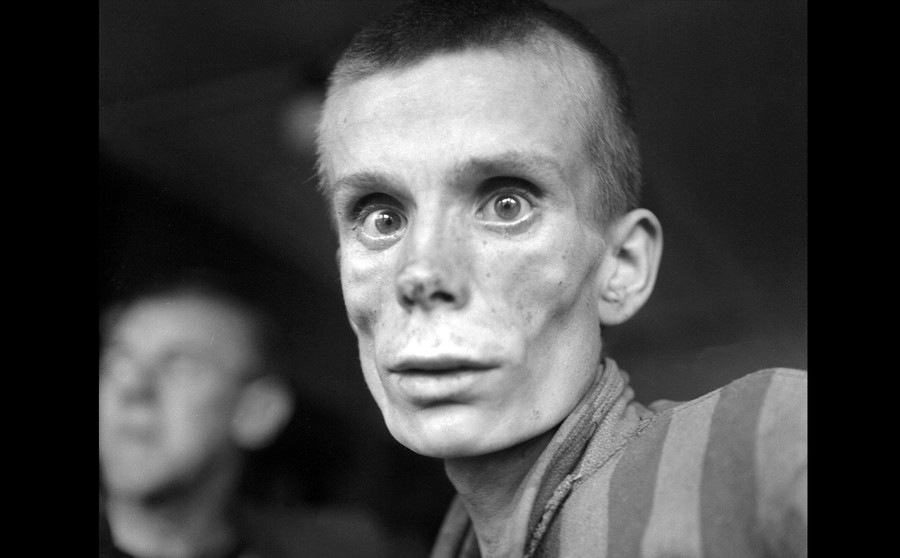
An emaciated 18-twelvemonth-old Russian girl looks into the camera lens during the liberation of Dachau concentration camp in 1945. Dachau was the kickoff German concentration army camp, opened in 1933. More than 200,000 people were detained between 1933 and 1945, and 31,591 deaths were declared, almost from disease, malnutrition and suicide. Unlike Auschwitz, Dachau was non explicitly an extermination camp, but weather were so horrific that hundreds died every week. #
Eric Schwab/AFP/Getty Images
-
-
 Read more
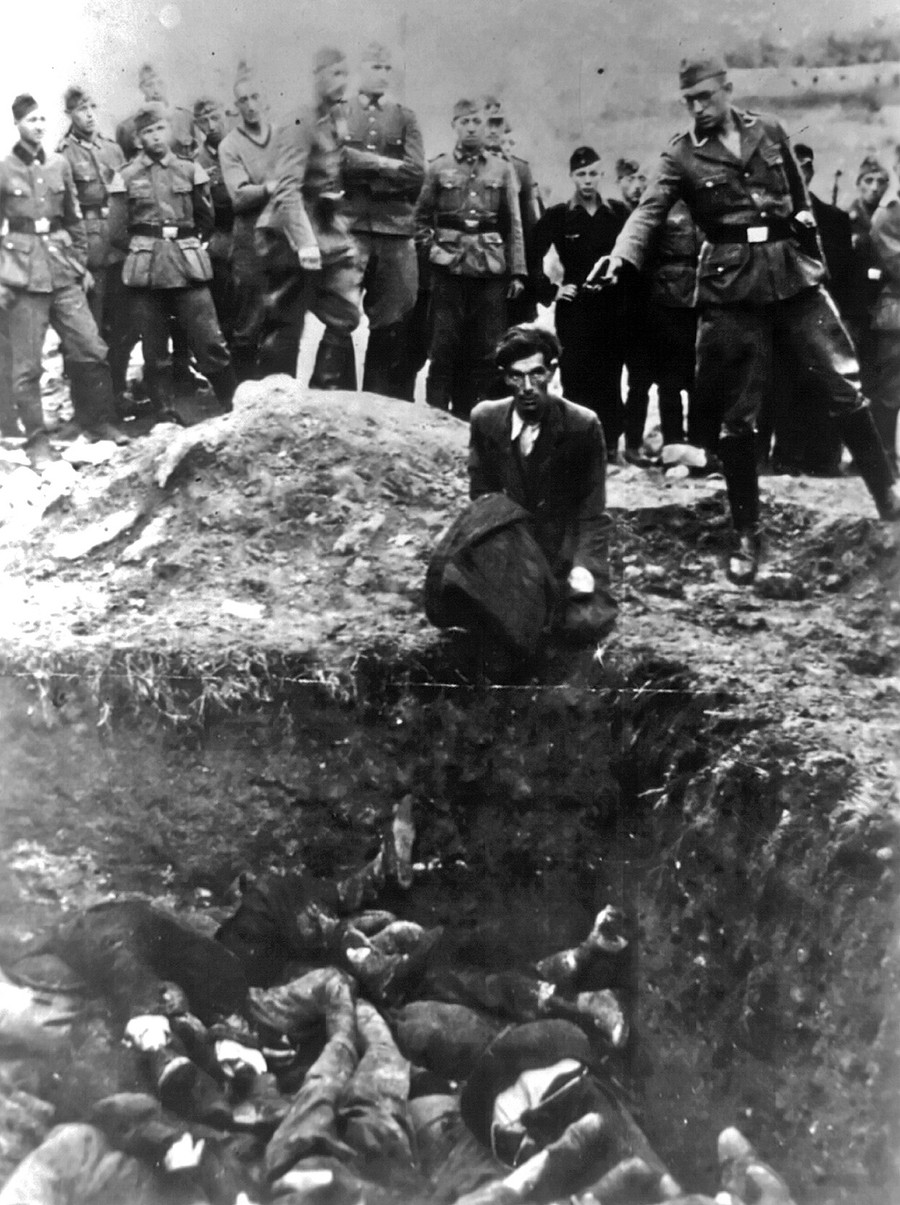
This photo provided by Paris' Holocaust Memorial shows a High german soldier shooting a Ukrainian Jew during a mass execution in Vinnytsia, Ukraine, erstwhile between 1941 and 1943. This epitome is titled "The last Jew in Vinnitsa", the text that was written on the back of the photograph, which was found in a photo album belonging to a German language soldier. #
AP Photograph/USHMM/LOC
-
 Read more
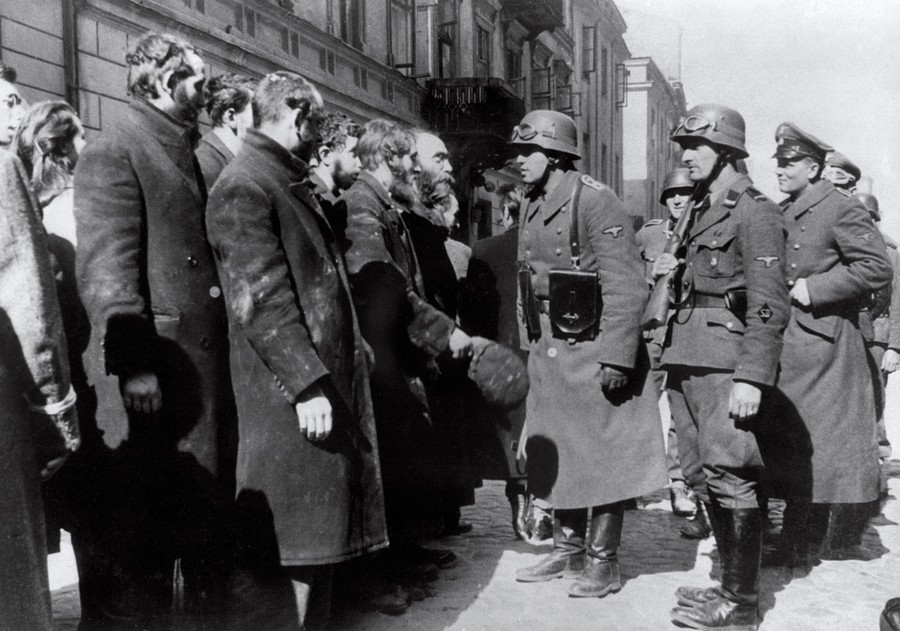
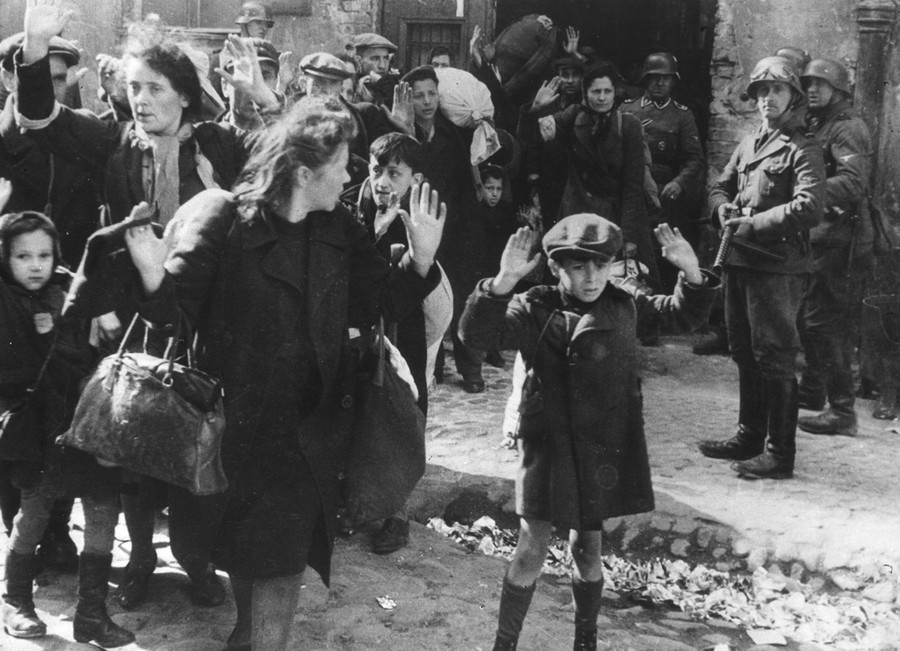
German soldiers question Jews afterward the Warsaw Ghetto Insurgence in 1943. In October 1940, the Germans began to concentrate Poland's population of over 3 meg Jews into overcrowded ghettos. In the largest of these, the Warsaw Ghetto, thousands of Jews died due to rampant disease and starvation, even earlier the Nazis began their massive deportations from the ghetto to the Treblinka extermination army camp. The Warsaw Ghetto Uprising -- the first urban mass rebellion against the Nazi occupation of Europe -- took place from April 19 until May 16 1943, and began after German language troops and constabulary entered the ghetto to bear its surviving inhabitants. It ended when the poorly-armed and supplied resistance was crushed past German language troops. #
OFF/AFP/Getty Images
-
 Read more than
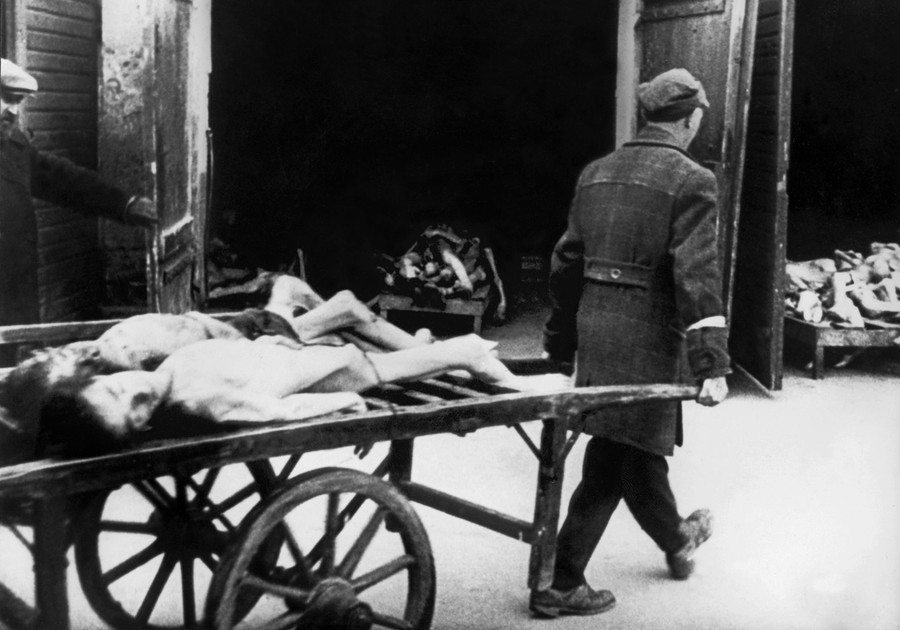
A homo carries abroad the bodies of expressionless Jews in the Ghetto of Warsaw in 1943, where people died of hunger in the streets. Every morning time, about 4-5 A.Chiliad., funeral carts collected a dozen or more than corpses from the streets. The bodies of the dead Jews were cremated in deep pits. #
AFP/Getty Images
-
 Read more than
A group of Jews, including a small boy, is escorted from the Warsaw Ghetto past High german soldiers in this April 19, 1943 photo. The picture formed part of a report from SS Gen. Stroop to his Commanding Officer, and was introduced every bit evidence to the War Crimes trials in Nuremberg in 1945. #
AP Photo
-
 Read more than
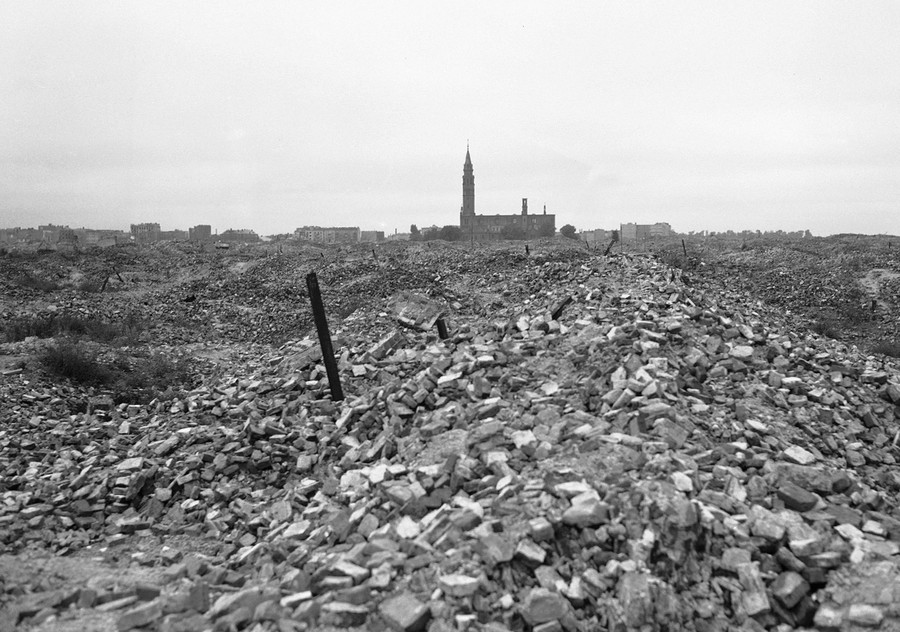
Subsequently the Warsaw Ghetto Insurgence, the Ghetto was completely destroyed. Of the more than 56,000 Jews captured, well-nigh 7,000 were shot, and the remainder were deported to killing centers or concentration camps. This is a view of the remains of the ghetto, which the German language SS dynamited to the ground. The Warsaw Ghetto merely existed for a few years, and in that time, some 300,000 Polish Jews lost their lives there. #
AP Photo
-
-
 Read more than
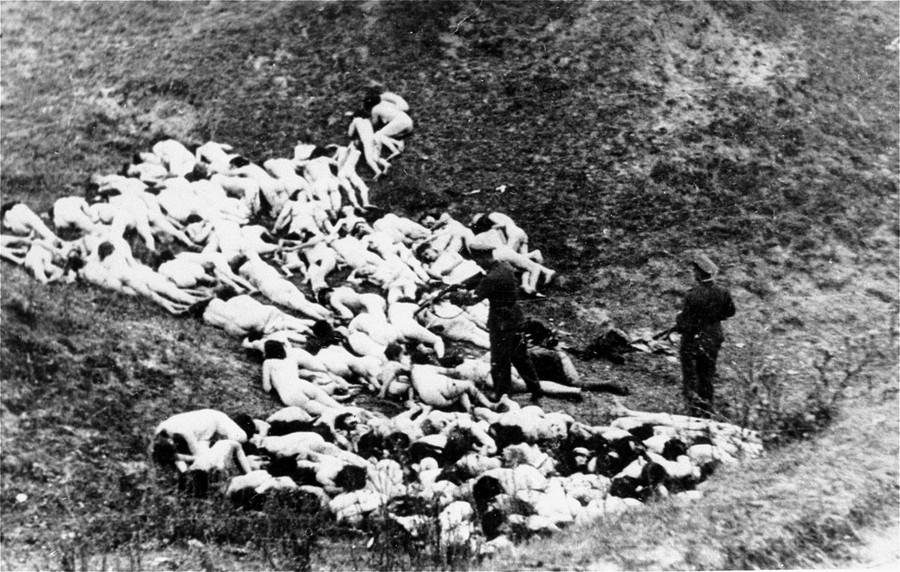
A German in a armed services uniform shoots at a Jewish woman subsequently a mass execution in Mizocz, Ukraine. In October of 1942, the 1,700 people in the Mizocz ghetto fought with Ukrainian auxiliaries and High german policemen who had intended to liquidate the population. Nigh half the residents were able to abscond or hibernate during the confusion before the insurgence was finally put down. The captured survivors were taken to a ravine and shot. Photograph provided by Paris' Holocaust Memorial. #
AP Photo/USHMM
-
 Read more
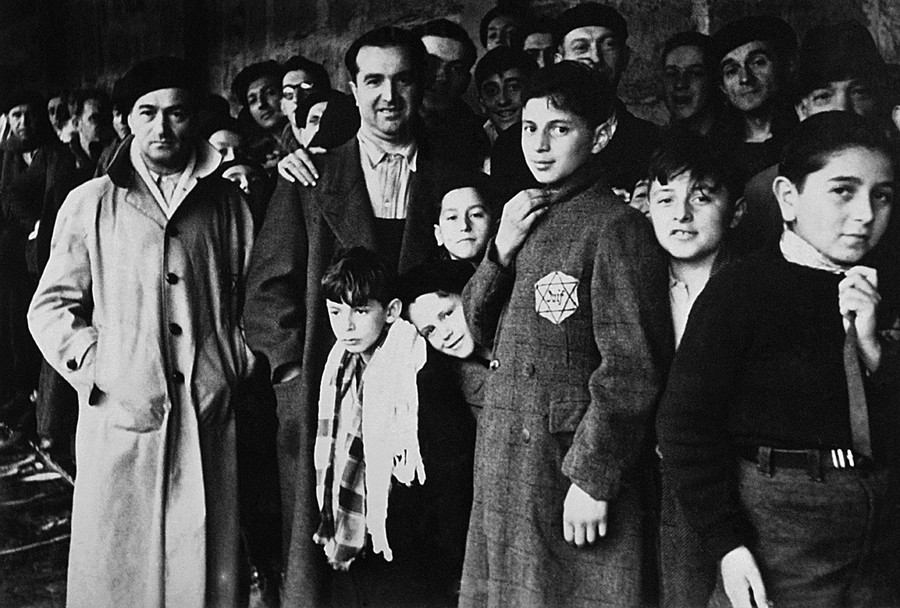
Jewish deportees in the Drancy transit campsite near Paris, French republic, in 1942, on their terminal stop before the German concentration camps. Some 13,152 Jews (including 4,115 children) were rounded upwardly by French police force forces, taken from their homes to the "Vel d'Hiv", or winter cycling stadium in southwestern Paris, in July of 1942. They were subsequently taken to a rails terminal at Drancy, northeast of the French capital, and then deported to the e. Only a handful e'er returned. #
AFP/Getty Images
-
 Read more
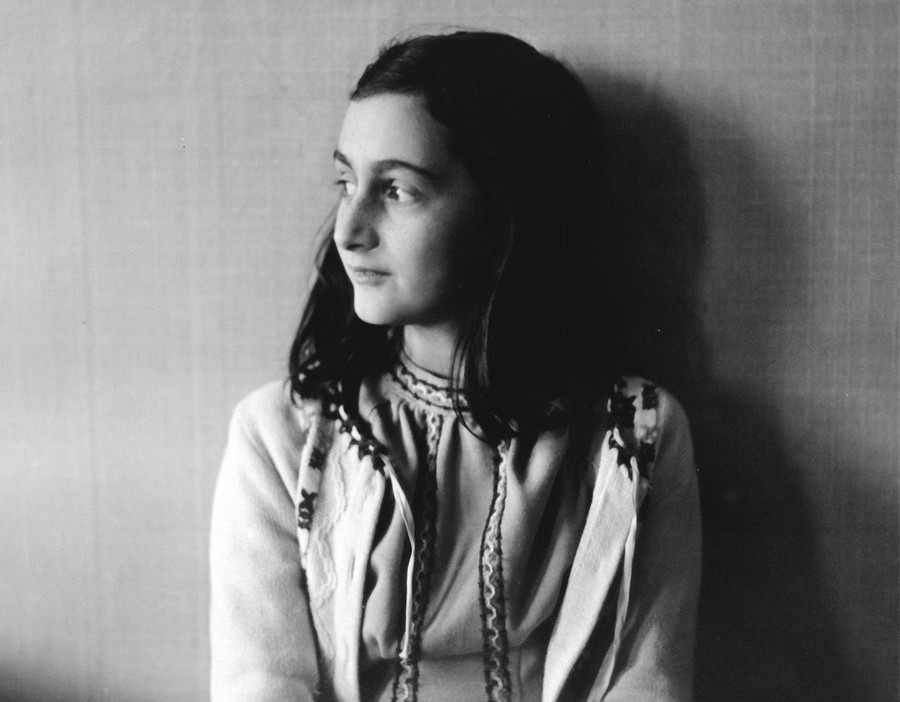
Anne Frank poses in 1941 in this photo made available by Anne Frank House in Amsterdam, Netherlands. In August of 1944, Anne, her family and others who were hiding from the occupying German Security forces, were all captured and shipped off to a serial of prisons and concentration camps. Anne died from typhus at age fifteen in Bergen-Belsen concentration camp, but her posthumously published diary has made her a symbol of all Jews killed in Earth War Ii. #
AP Photo/Anne Frank Business firm/Frans Dupont
-
 Read more
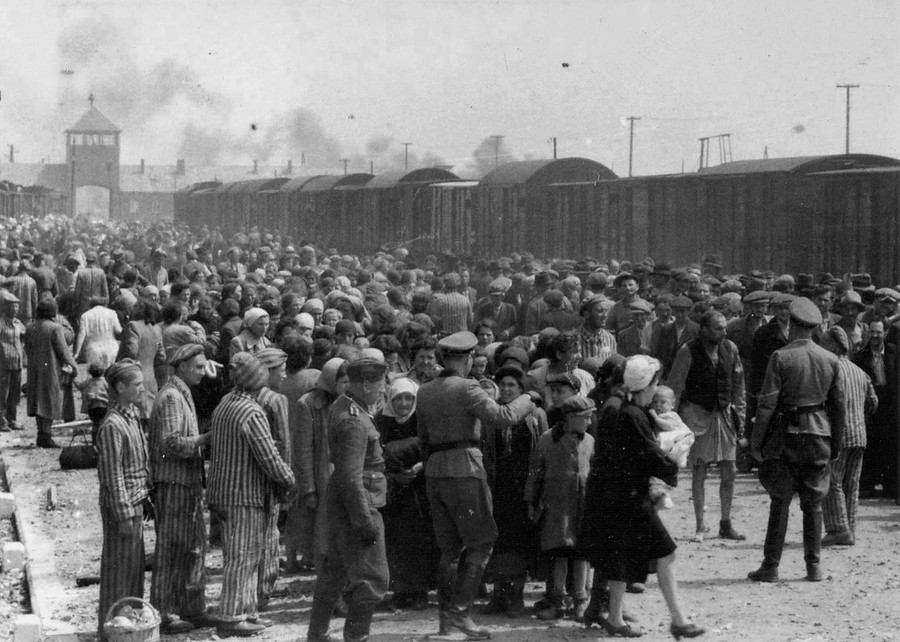
The inflow and processing of an entire ship of Jews from Carpatho-Ruthenia, a region annexed in 1939 to Hungary from Czechoslovakia, at Auschwitz-Birkenau extermination campsite in Poland, in May of 1944. The picture was donated to Yad Vashem in 1980 by Lili Jacob. #
AP Photo/Yad Vashem Photo Archives
-
 Read more
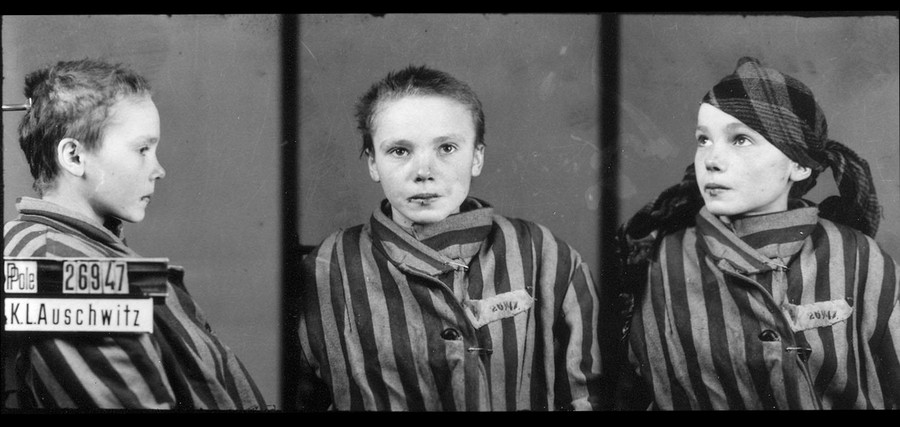
Czeslawa Kwoka, age 14, appears in a prisoner identity photograph provided by the Auschwitz Museum, taken by Wilhelm Brasse while working in the photography department at Auschwitz, the Nazi-run decease camp where some 1.5 million people, well-nigh of them Jewish, died during World State of war Two. Czeslawa was a Smooth Cosmic girl, from Wolka Zlojecka, Poland, who was sent to Auschwitz with her mother in December of 1942. Within three months, both were expressionless. Photographer (and fellow prisoner) Brasse recalled photographing Czeslawa in a 2005 documentary: "She was so immature and then terrified. The girl didn't understand why she was in that location and she couldn't understand what was being said to her. So this adult female Kapo (a prisoner overseer) took a stick and beat her about the face. This German woman was just taking out her anger on the daughter. Such a beautiful young girl, then innocent. She cried but she could do nothing. Earlier the photograph was taken, the girl dried her tears and the blood from the cut on her lip. To tell y'all the truth, I felt every bit if I was being striking myself just I couldn't interfere. It would have been fatal for me." #
AP Photo/Auschwitz Museum
-
-
 Read more
A victim of Nazi medical experimentation. A victim's arm shows a deep burn from phosphorus at Ravensbrueck, Deutschland, in Nov of 1943. The photograph shows the results of a medical experiment dealing with phosphorous that was carried out by doctors at Ravensbrueck. In the experiment, a mixture of phosphorus and rubber was practical to the skin and ignited. After twenty seconds, the burn down was extinguished with water. Afterward three days, the burn was treated with Echinacin in liquid form. Later on two weeks the wound had healed. This photograph, taken by a camp doctor, was entered as bear witness during the Doctors Trial at Nuremberg. #
U.S. Holocaust Memorial Museum, NARA
-
 Read more
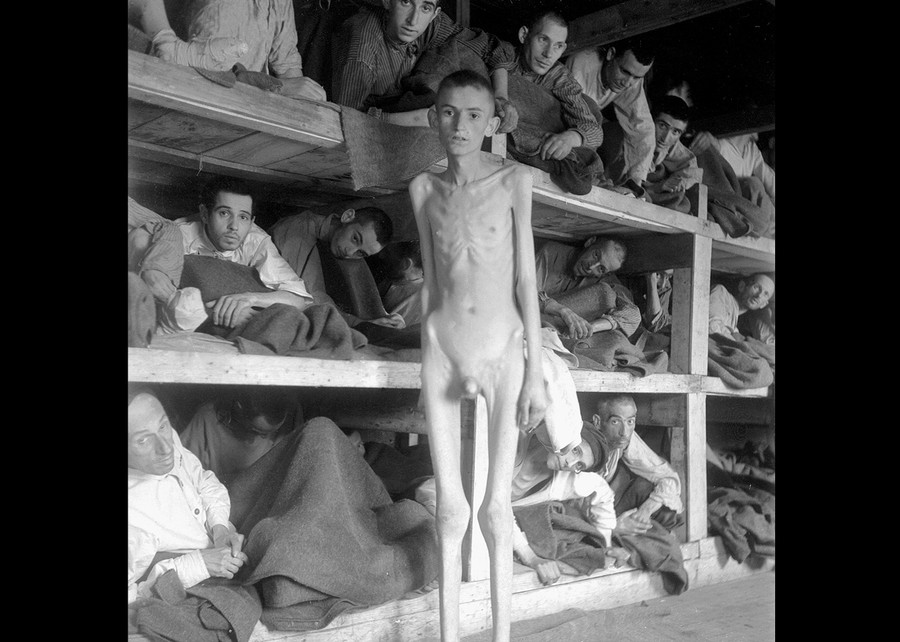
Jewish prisoners in Buchenwald concentration camp, after the liberation of the camp in 1945. #
AFP/Getty Images
-
 Read more
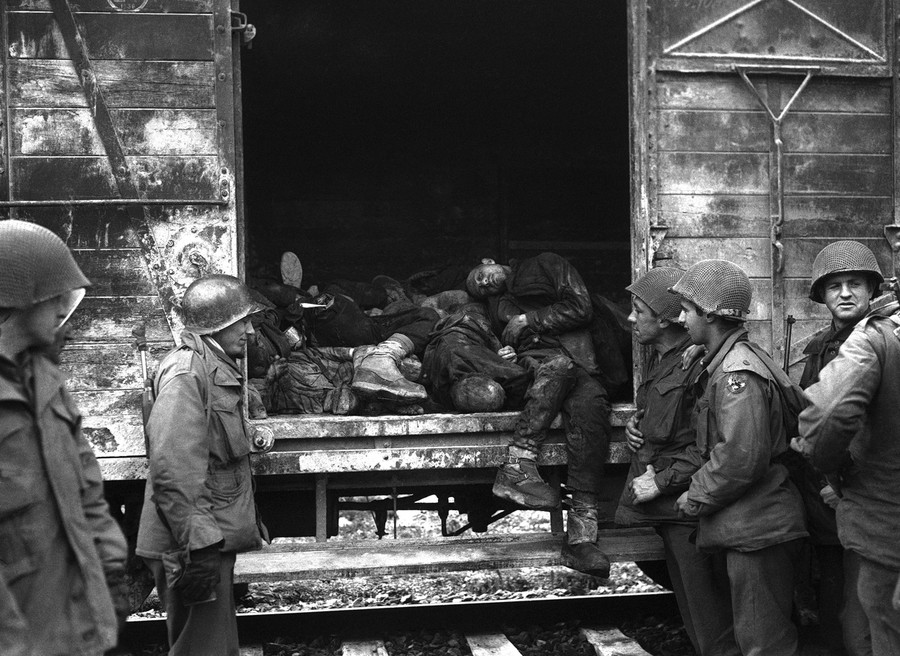
American soldiers silently audit some of the rail trucks loaded with expressionless which were found on the rail siding at the Dachau concentration army camp in Germany, on May 3, 1945. #
AP Photo
-
 Read more
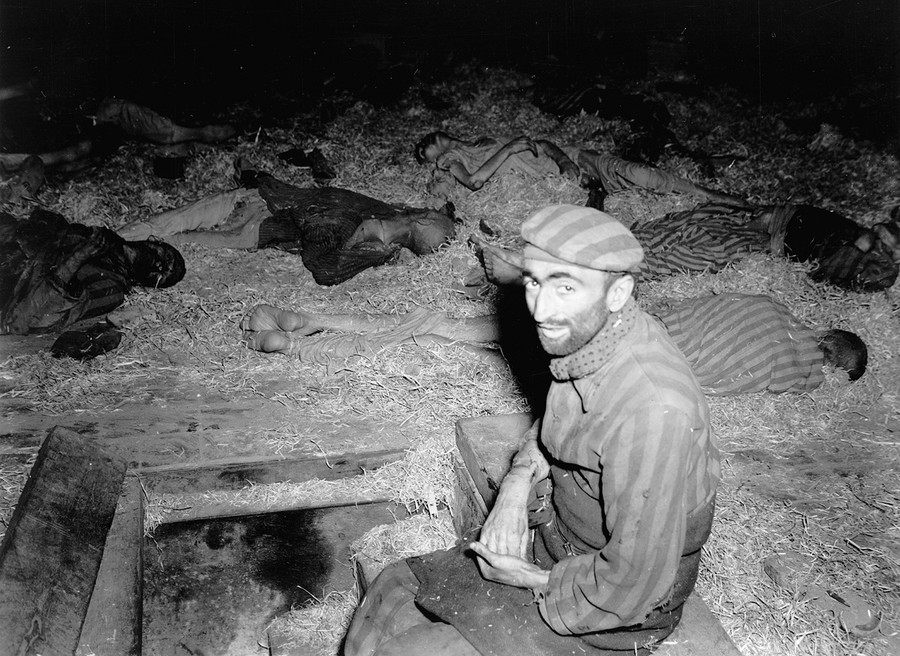
A starved Frenchman sits amongst the expressionless in a sub-camp of the Mittelbau-Dora labor camp, in Nordhausen, Germany, in April of 1945. #
U.S. Regular army/LOC
-
 Read more than
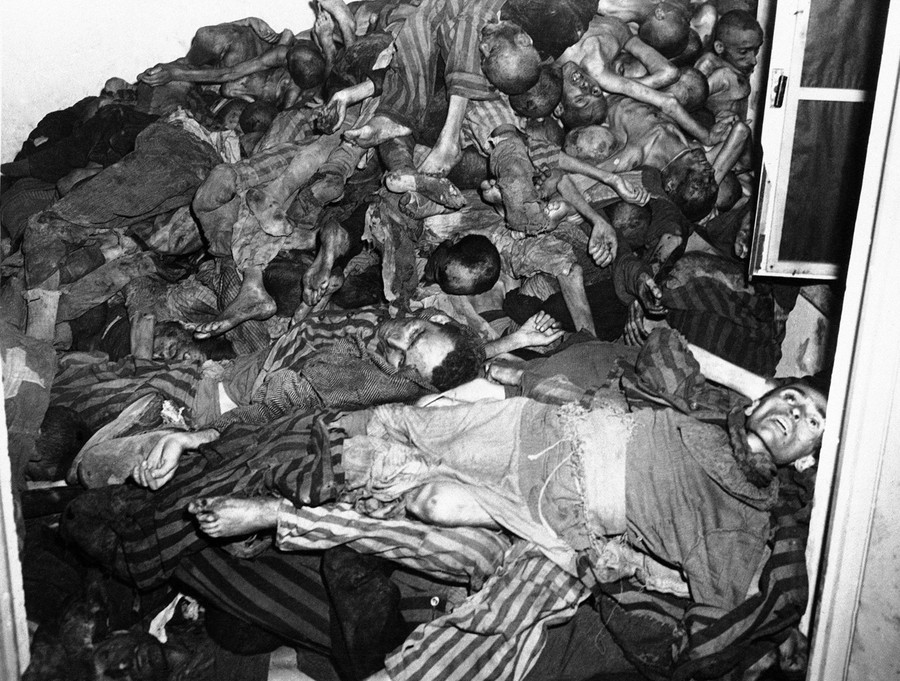
Bodies lie piled against the walls of a crematory room in a High german concentration camp in Dachau, Germany. The bodies were found past U.S. Seventh Ground forces troops who took the camp on May xiv, 1945. #
AP Photo
-
-
 Read more than
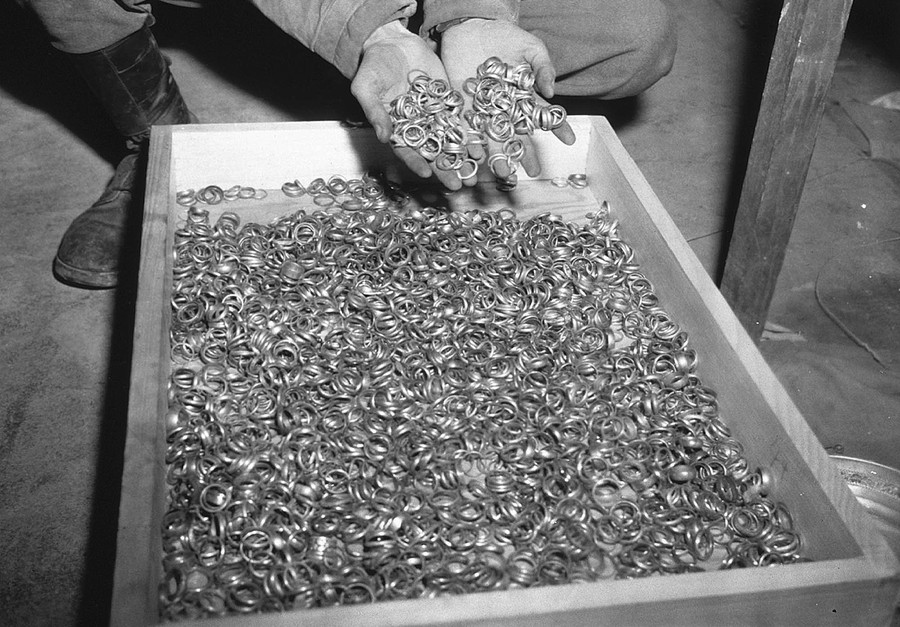
A U.Due south. soldier inspects thousands of gold hymeneals bands taken from Jews by the Germans and stashed in the Heilbronn Table salt Mines, on May iii, 1945 in Germany. #
AFP/NARA
-
 Read more
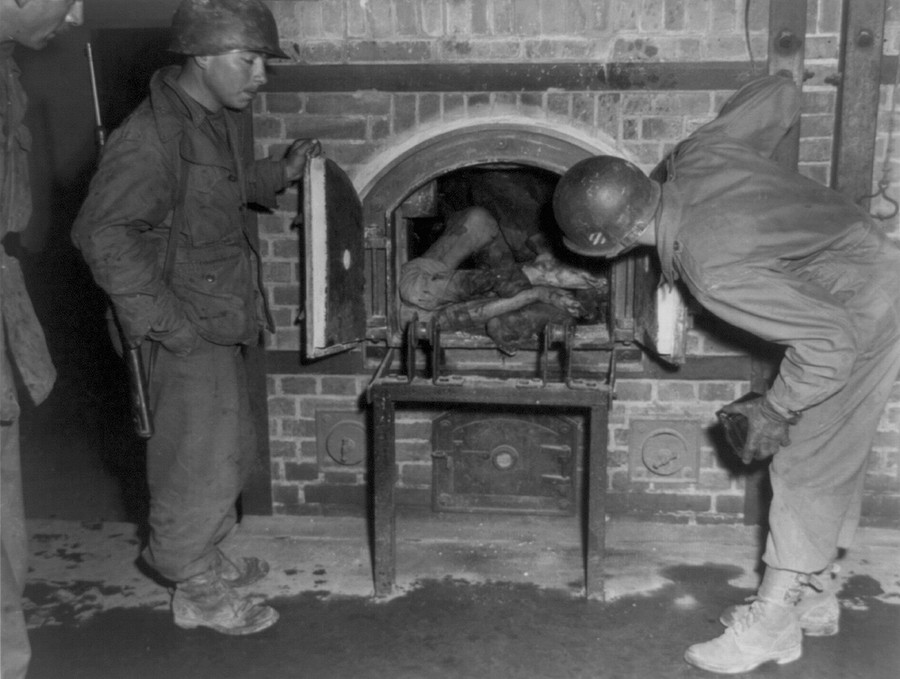
Three U.S. soldiers look at bodies stuffed into an oven in a crematorium in April of 1945. Photo taken in an unidentified concentration camp in Germany, at fourth dimension of liberation by U.Southward. Army. #
U.South. Ground forces/LOC
-
 Read more
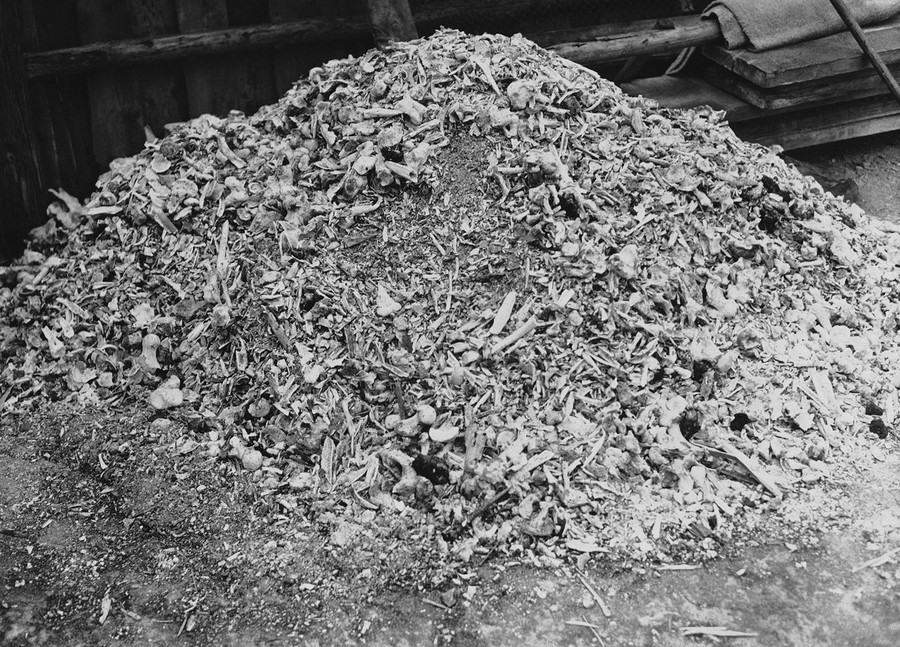
This heap of ashes and bones is the debris from i twenty-four hours's killing of German prisoners past 88 troopers in the Buchenwald concentration camp most Weimar in Germany, shown on April 25, 1945. #
AP Photo/U.S. Ground forces Bespeak Corps
-
 Read more
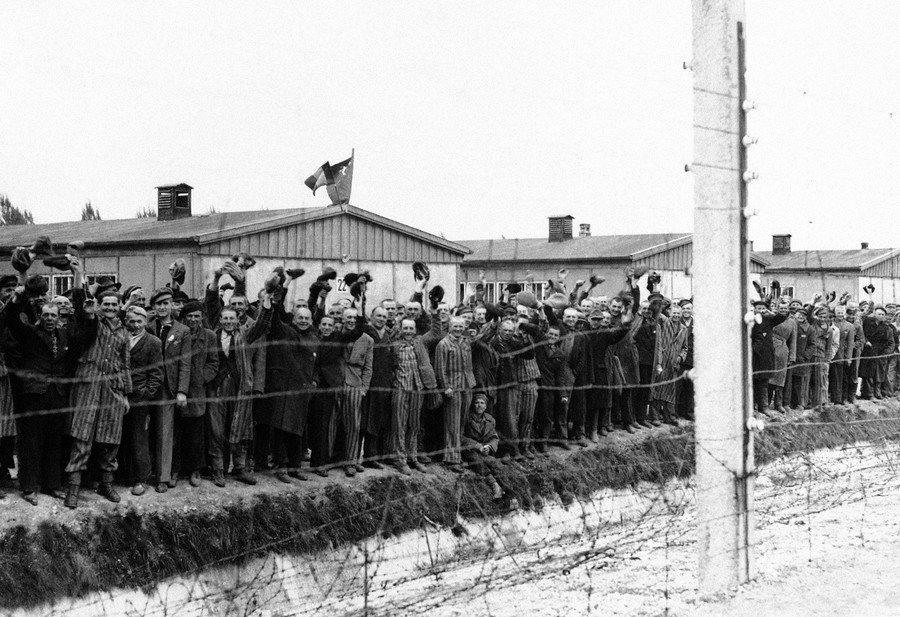
Prisoners at the electric fence of Dachau concentration camp cheer American soldiers in Dachau, Frg in an undated photo. Some of them habiliment the striped blue and white prison garb. They decorated their huts with flags of all nations which they had made secretly as they heard the guns of the 42nd Rainbow Division getting louder and louder on the approach to Dachau. #
AP Photo
-
 Read more
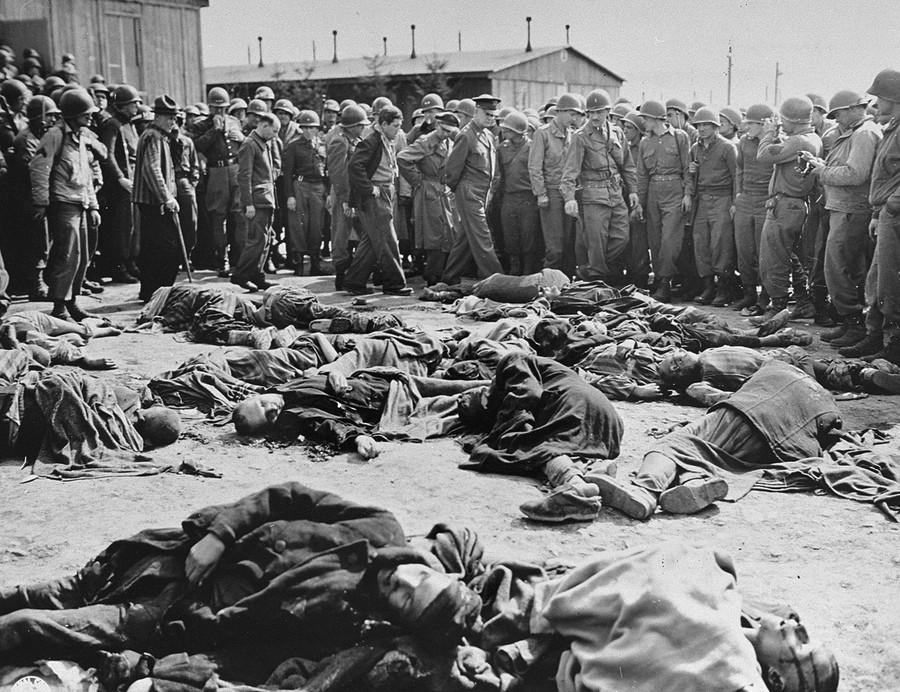
General Dwight D. Eisenhower and other American officers in the Ohrdruf concentration camp, shortly after the liberation of the camp in April of 1945. As American forces approached, the guards shot the remaining prisoners. #
U.S. Army Betoken Corps/NARA
-
-
 Read more
A dying prisoner, too weak to sit up among his rags and filth, victim of starvation and incredible brutality, at the Nordhausen concentration camp in Germany on Apr xviii, 1945. #
AP Photograph
-
 Read more
Prisoners on a death march from Dachau movement towards the south along the Noerdliche Muenchner Street in Gruenwald, Germany, on Apr 29, 1945. Many thousands of prisoners were marched forcibly from outlying prison camps to camps deeper inside Germany equally Allied forces closed in. Thousands died along the way, anyone unable to keep upwardly was executed on the spot. Pictured, fourth from the right, is Dimitry Gorky who was born on Baronial nineteen, 1920 in Blagoslovskoe, Russia to a family of peasant farmers. During Earth War II Dmitry was imprisoned in Dachau for 22 months. The reason for his imprisonment is not known. Photo released by the U.S. Holocaust Memorial Museum. #
AP Photo/USHMM, courtesy of KZ Gedenkstaette Dachau
-
 Read more than
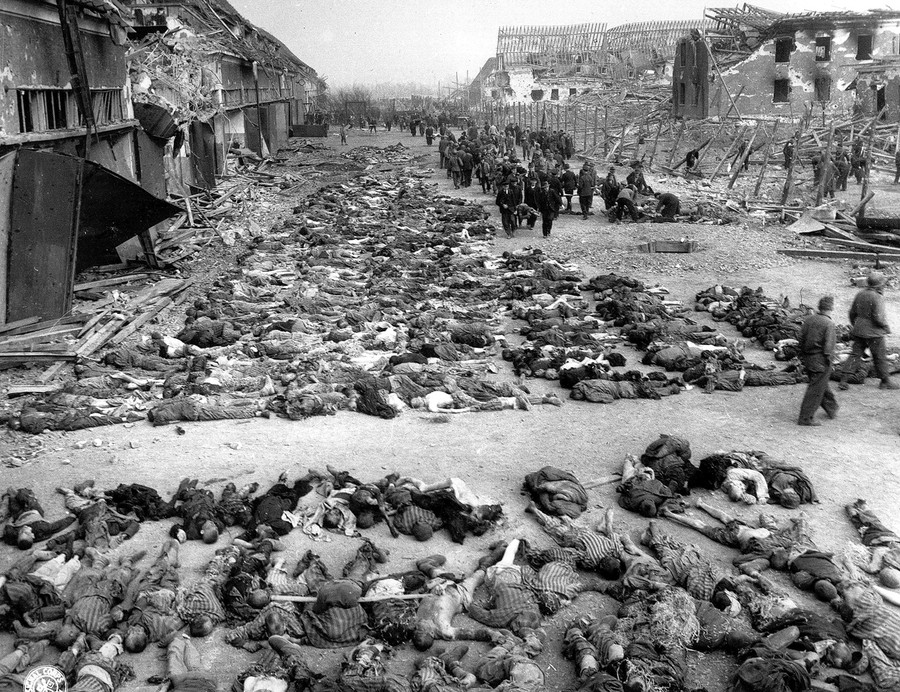
American soldiers walk by row after row of corpses lying on the ground beside barracks at the Nazi concentration camp at Nordhausen, Germany, on April 17, 1945. The military camp is located about 70 miles west of Leipzig. As the camp was liberated on April 12, the U.Due south. Army found more than three,000 bodies, and a scattering of survivors. #
AP Photo/United states of america Army Signal Corps
-
 Read more than
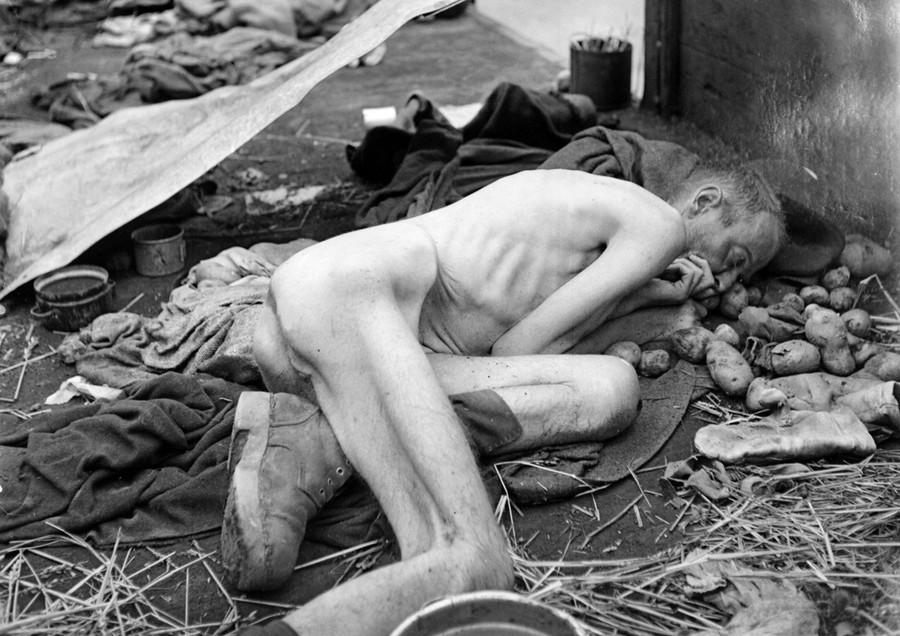
A dead prisoner lies in a train railroad vehicle near Dachau concentration campsite in May of 1945. #
Eric Schwab/AFP/Getty Images
-
 Read more
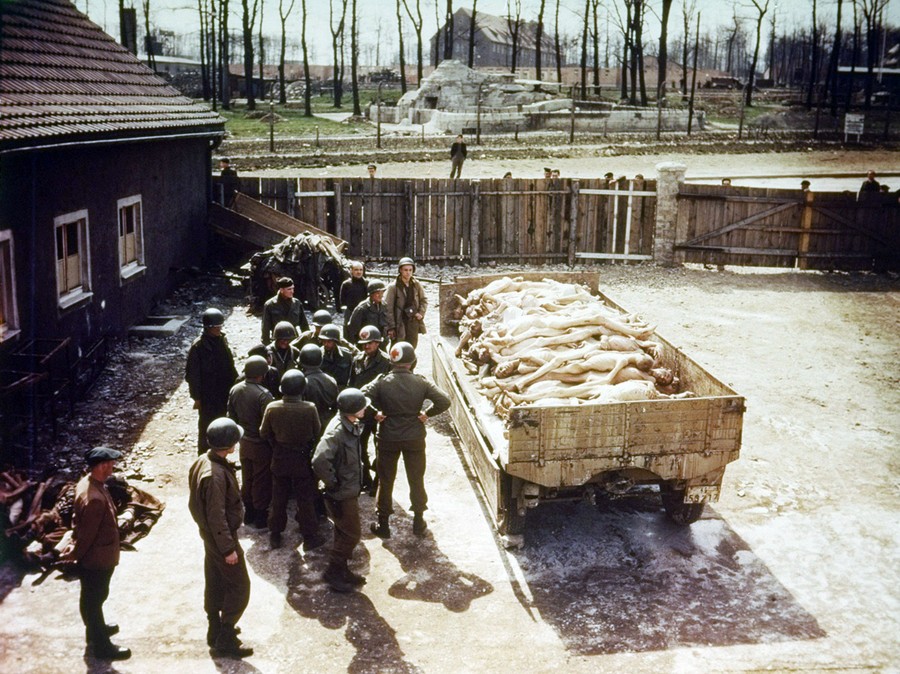
Liberating soldiers of Lt. General George S. Patton's third Army, XX Corps, are shown at Buchenwald concentration camp near Weimar, Germany, on April 11, 1945. #
AP Photograph/U.S. Army
-
-
 Read more
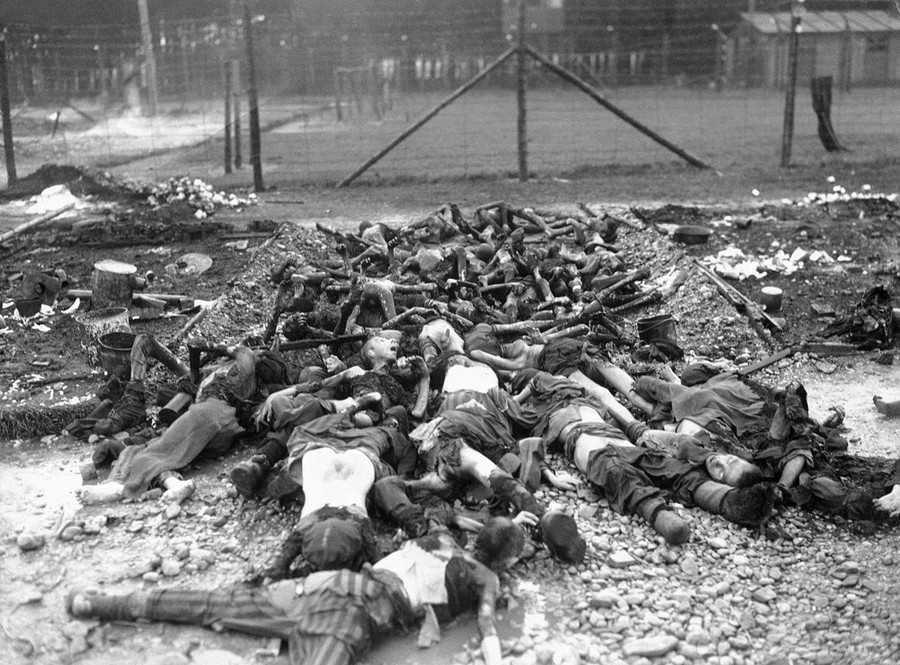
Full general Patch's 12th Armored Division, forging their way towards the Austrian border, uncovered horrors at a High german prison house military camp at Schwabmunchen, southwest of Munich. Over 4,000 slave laborers, all Jews of various nationalities, were housed in the prison house. The internees were burned alive by guards who set fire to the crude huts in which the prisoners slept, shooting whatever who tried to escape. Sprawled hither in the prison house enclosure are the burnt bodies of some of the Jewish slave laborers uncovered by the US 7th Ground forces at Schwabmunchen, May 1, 1945. #
AP Photo/Jim Pringle
-
 Read more
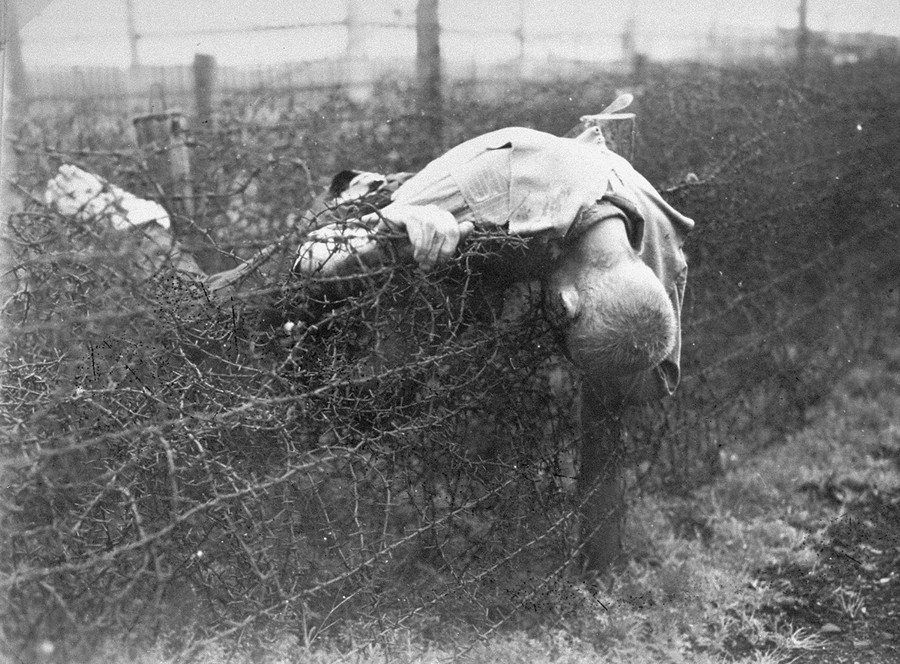
The corpse of a prisoner lies on the barbed wire fence in Leipzig-Thekla, a sub-campsite of Buchenwald, near Weimar, Federal republic of germany. #
NARA
-
 Read more
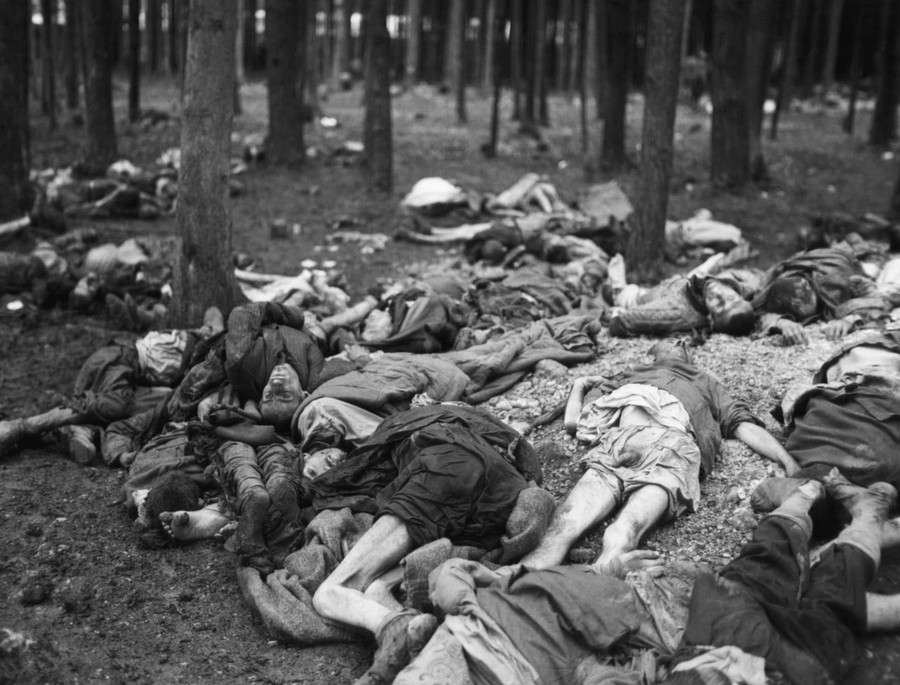
These expressionless victims of the Germans were removed from the Lambach concentration camp in Austria, on May vi, 1945, past German language soldiers under orders of U.Due south. Army troops. As soon as all the bodies were removed from the military camp, the Germans buried them. This camp originally held xviii,000 people, each building housing ane,600. In that location were no beds or germ-free facilities whatsoever, and twoscore to l prisoners died each day. #
AP Photo
-
 Read more
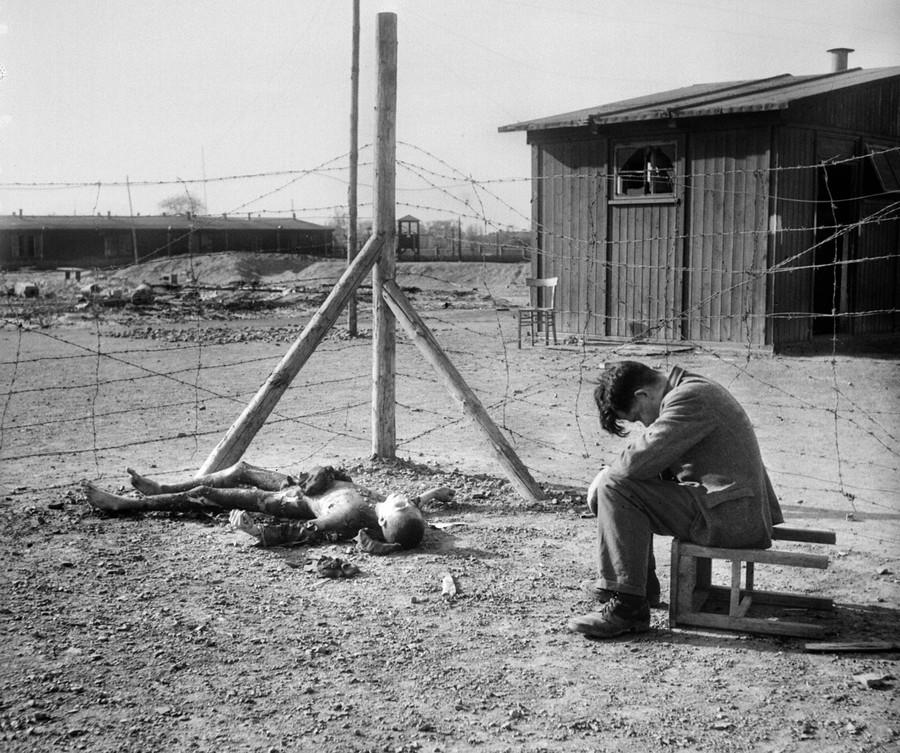
A young human being sits on an overturned stool next to a burnt body in the Thekla camp outside Leipzig, in April of 1945, subsequently the United states troops entered Leipzig April 18. On the 18th of April, the workers of the Thekla plane manufactory were locked in an isolated building of the factory by the Germans and burned alive by incendiary bombs. About 300 prisoners died. Those who managed to escape died on the barbed wire or were executed by the Hitler youth movement, according to a US captain'south report. #
Eric Schwab/AFP/Getty Images
-
 Read more
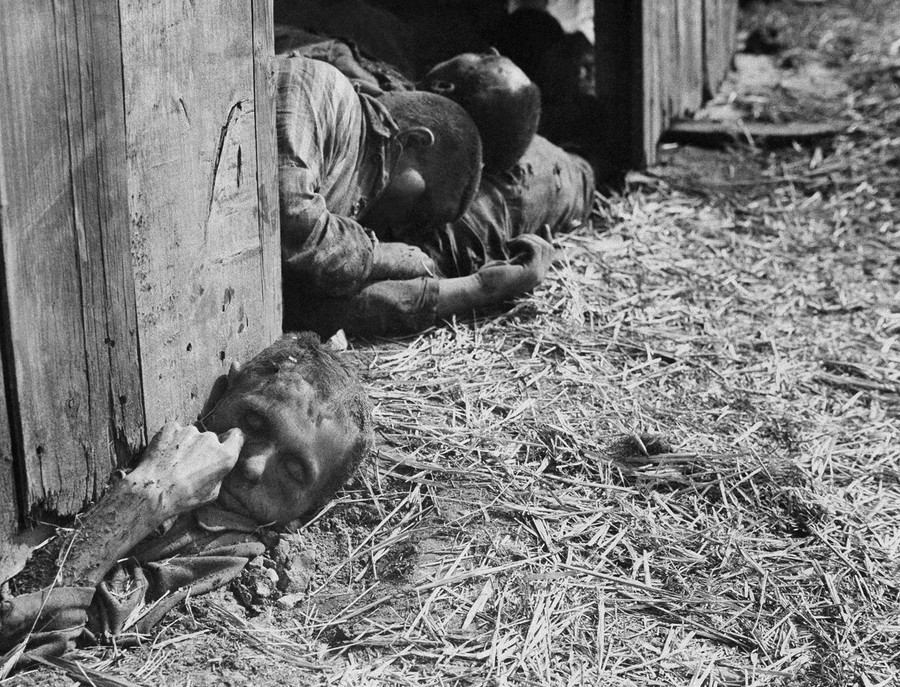
Burned bodies of political prisoners of the Germans lie strewn about the entrance to a befouled at Gardelegen, Germany on Apr sixteen, 1945 where they met their expiry a the easily of German SS troops who gear up the barn on burn. The group tried to escape and was shot by the SS troops. Of the 1,100 prisoners, but 12 managed to escape. #
AP Photo/U.S. Ground forces Signal Corps
-
-
 Read more
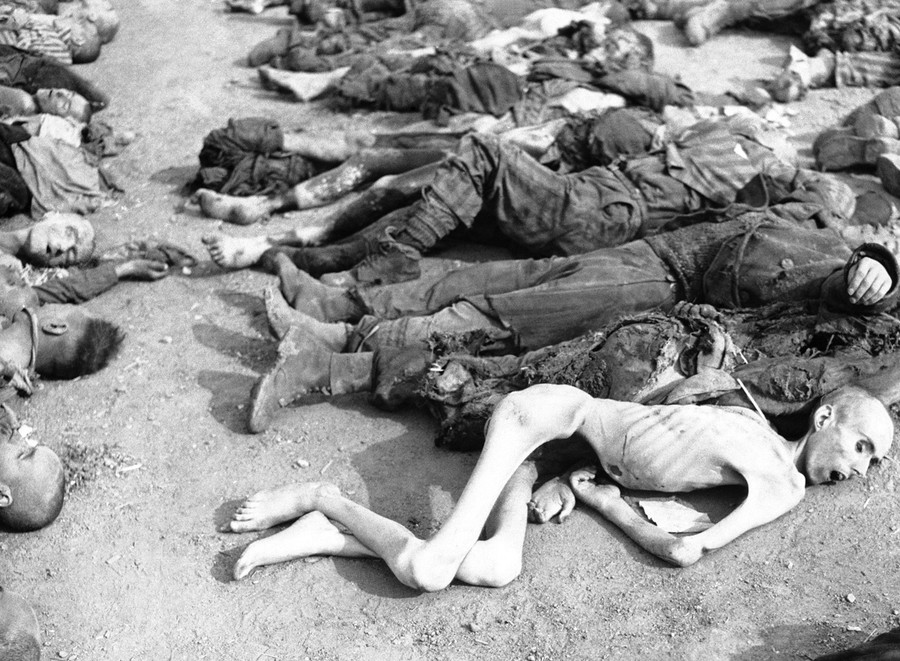
Some of the skeleton-like human remains found by men of the Third Armored Division, U.S. Starting time Regular army, at the High german concentration campsite at Nordhausen on Apr 25, 1945, where hundreds of "slave laborers" of various nationalities lay dead and dying. #
AP Photo
-
 Read more than
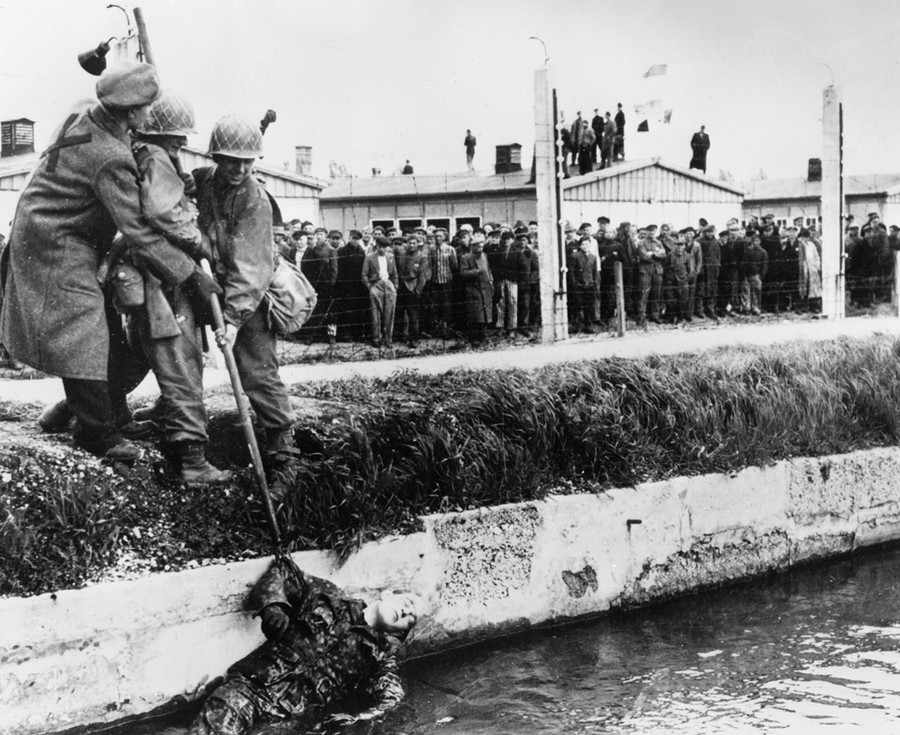
When American troops liberated prisoners in the Dachau concentration camp, Deutschland, in 1945, many German SS guards were killed by the prisoners who then threw their bodies into the moat surrounding the military camp. #
AP Photo
-
 Read more
Lt. Col. Ed Seiller of Louisville, Kentucky, stands amid a pile of Holocaust victims every bit he speaks to 200 German civilians who were forced to come across the grim conditions at the Landsberg concentration camp, on May fifteen, 1945. #
AP Photograph
-
 Read more
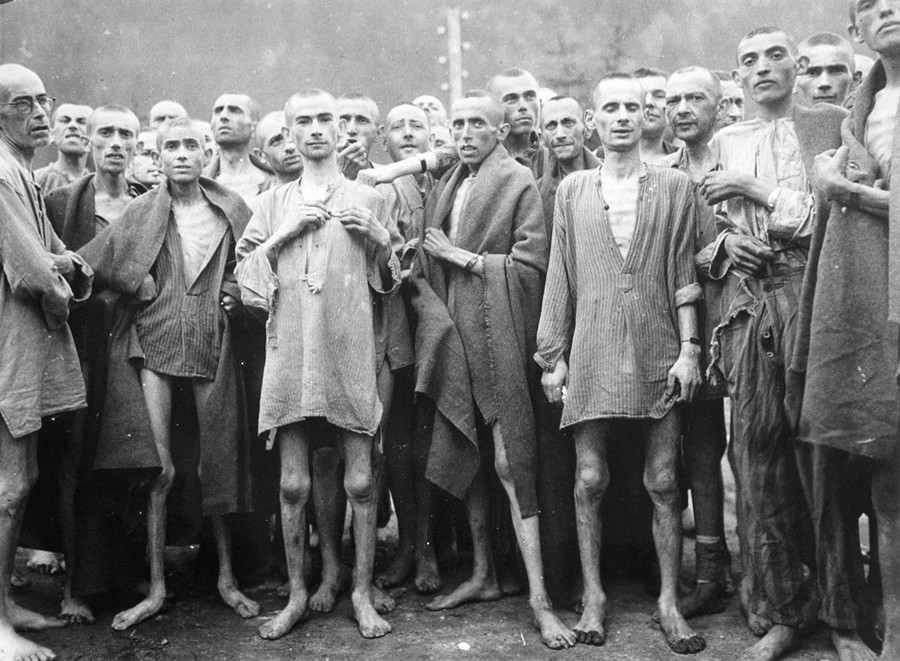
Starved prisoners, near expressionless from hunger, pose in a concentration camp in Ebensee, Austria, on May seven, 1945. The camp was reputedly used for "scientific" experiments. #
NARA/Newsmakers
-
 Read more
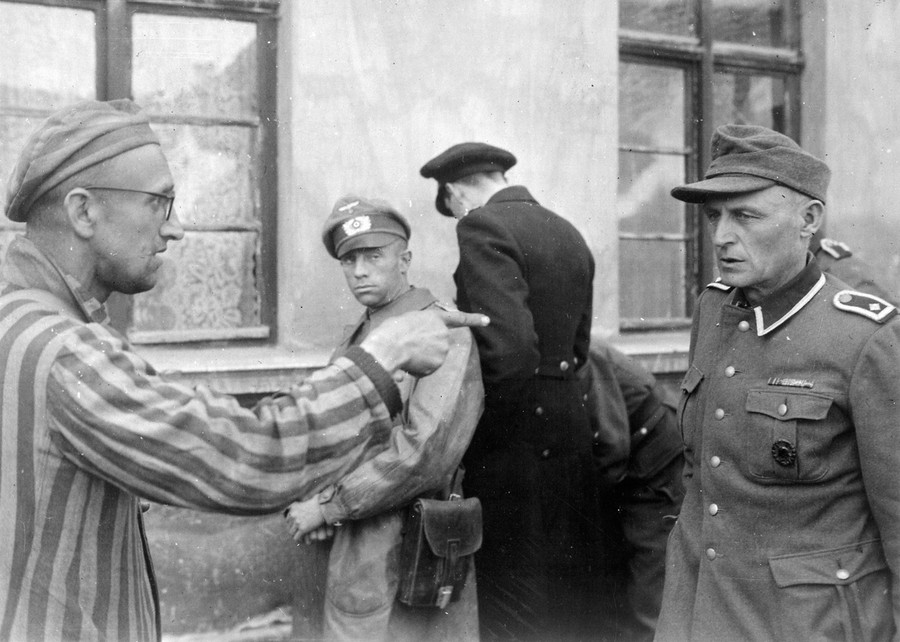
A Russian survivor, liberated by the tertiary Armored Division of the U.Southward. First Ground forces, identifies a former camp baby-sit who brutally crush prisoners on Apr 14, 1945, at the Buchenwald concentration military camp in Thuringia, Germany. #
AP Photo
-
-
 Read more
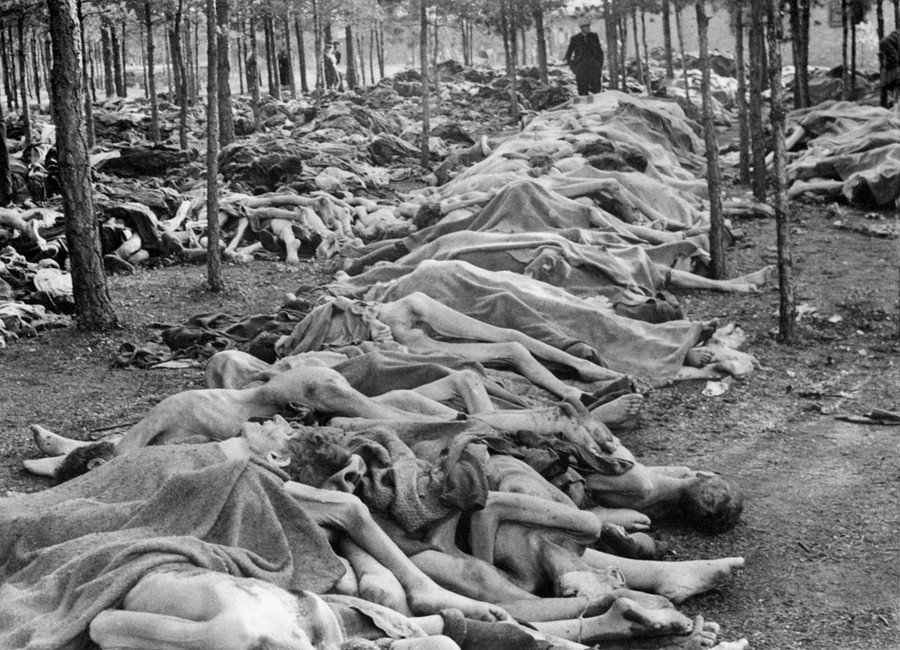
Expressionless bodies piled upwardly in Bergen-Belsen concentration camp after the British troops liberated the army camp on April 15, 1945. The British found sixty,000 men, women and children dying of starvation and illness. #
AFP/Getty Images
-
 Read more
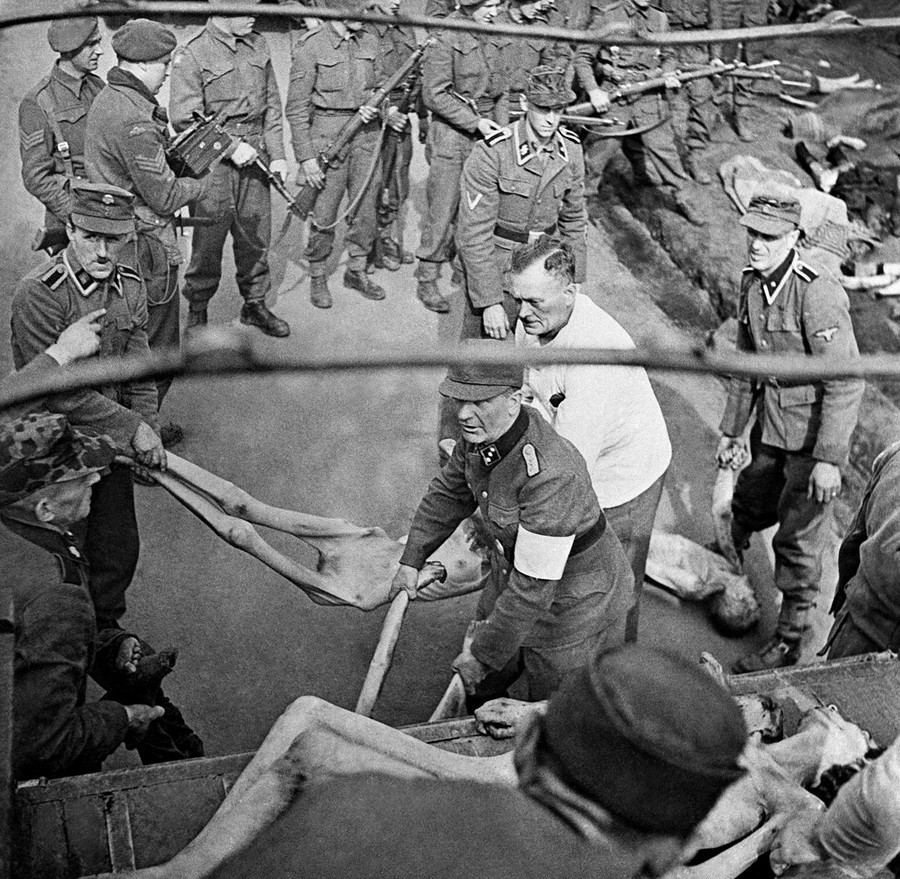
German SS troops load victims of Bergen-Belsen concentration army camp into trucks for burial, in Belsen, Germany, on April 17, 1945. British guards hold rifles in the background. #
AP Photo/British Official Photograph
-
 Read more than
Citizens of Ludwigslust, Deutschland, inspect a nearby concentration camp under orders of the 82nd Airborne Partition on May 6, 1945. Bodies of victims of German language prison camps were institute dumped in pits in yard, one pit containing 300 bodies. #
NARA
-
 Read more
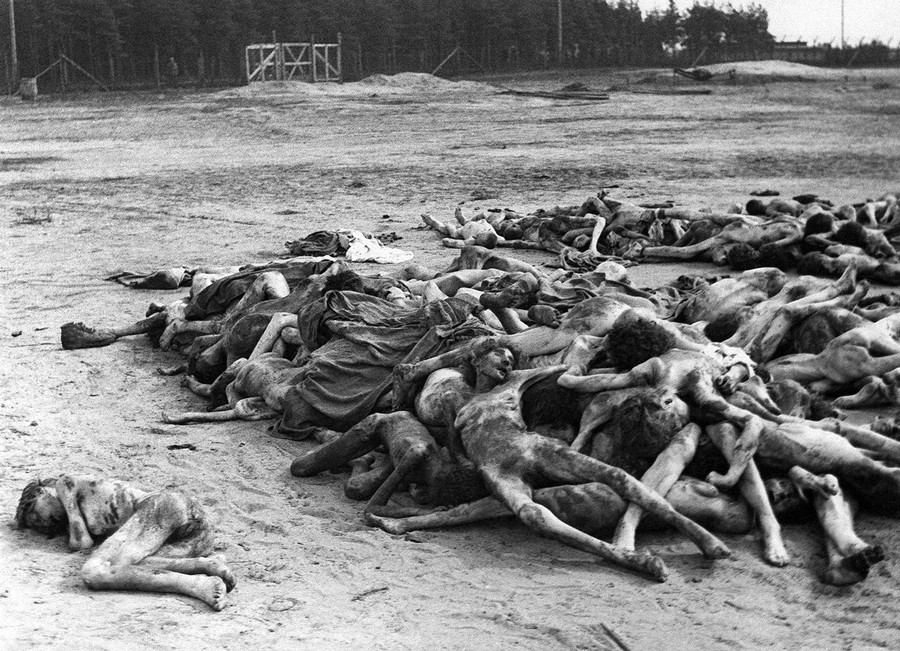
A pile of bodies left to rot in the Bergen-Belsen campsite, in Bergen, Frg, found afterward the camp was liberated by British forces on April 20, 1945. Some 60,000 civilians, most suffering from typhus, typhoid and dysentery, were dying past the hundreds daily, despite the frantic efforts by medical services rushed to the army camp. #
AP Photo
-
 Read more than
Manacled following his arrest is Joseph Kramer, commandant of the Bergen-Belsen concentration camp in Belsen, photographed on April 28, 1945. After standing trial, Kramer, "The Animate being of Belsen", was convicted and executed in December of 1945. #
AP Photo
-
-
 Read more than
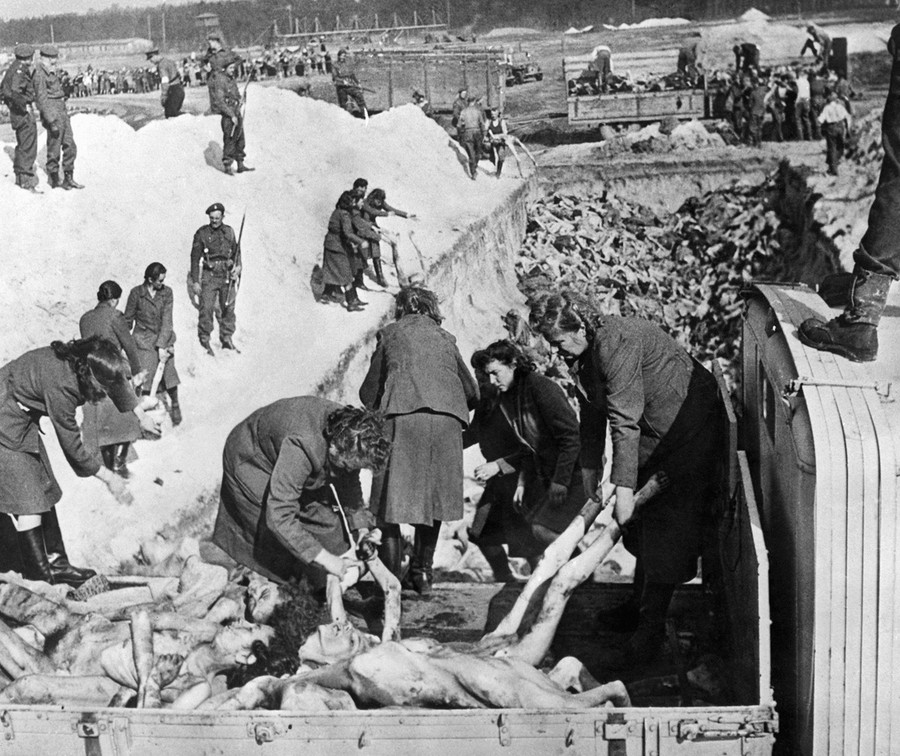
High german SS women remove bodies of their victims from trucks in the concentration campsite at Belsen, Germany, on April 28, 1945. Starvation and disease killed hundreds of the many thousands imprisoned at the military camp. British soldiers holding rifles in the background stand on the dirt which will make full the communal grave. #
AP Photo/British official photo
-
 Read more than
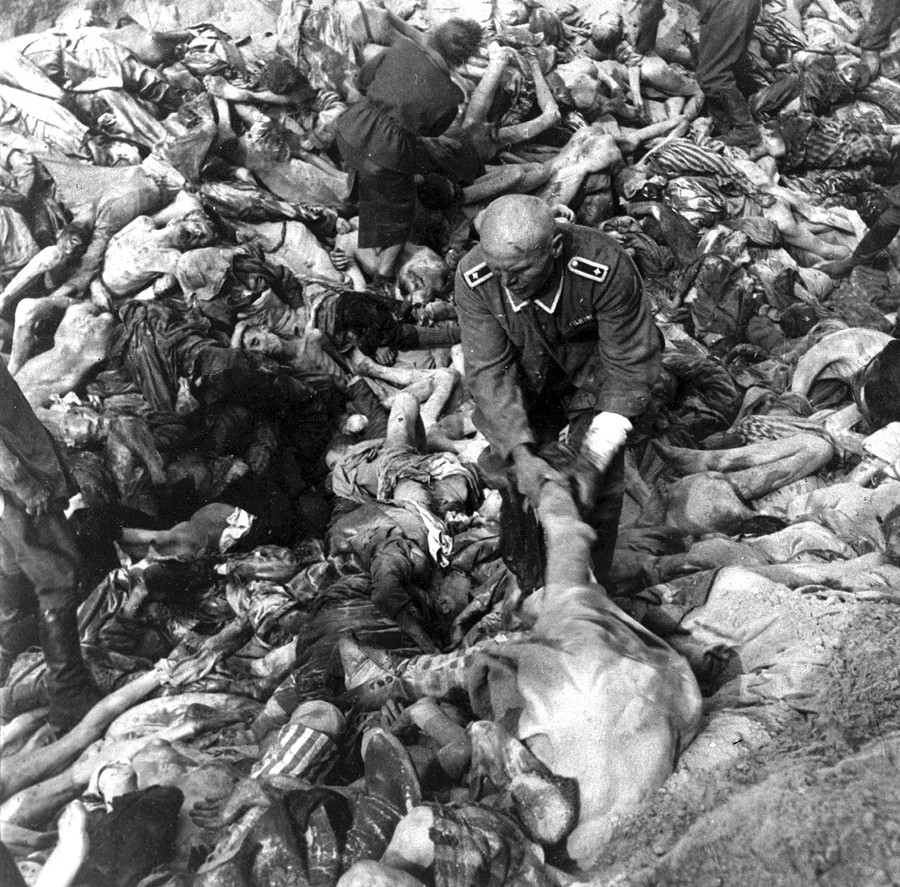
A German language SS guard, standing amid hundreds of corpses, hauls another body of a concentration military camp victim into a mass grave in Belsen, Germany in April of 1945. #
AP Photo
-
 Read more than
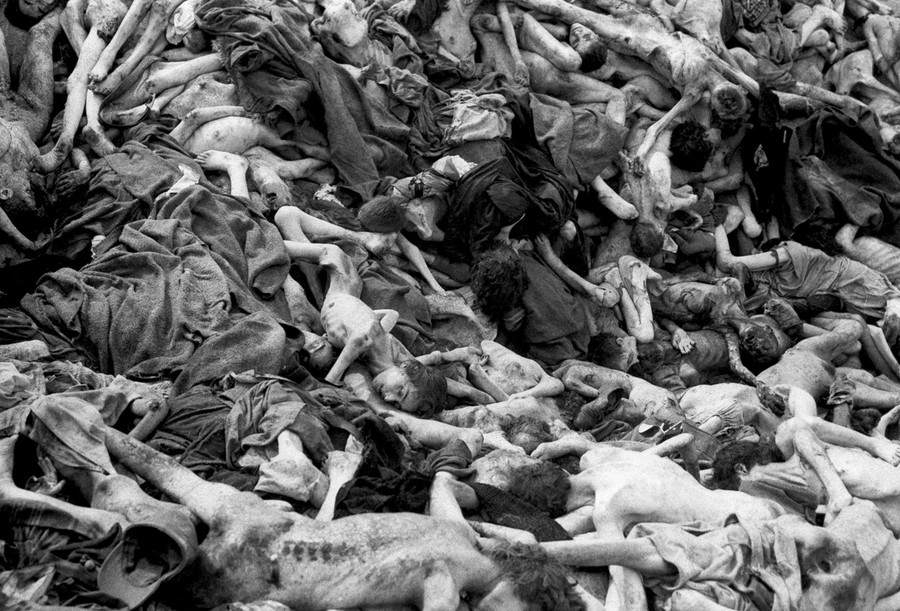
Piles of the dead at Bergen-Belsen concentration military camp on Apr 30, 1945. Some 100,000 people are estimated to have died in this ane camp alone. #
AP Photo
-
 Read more
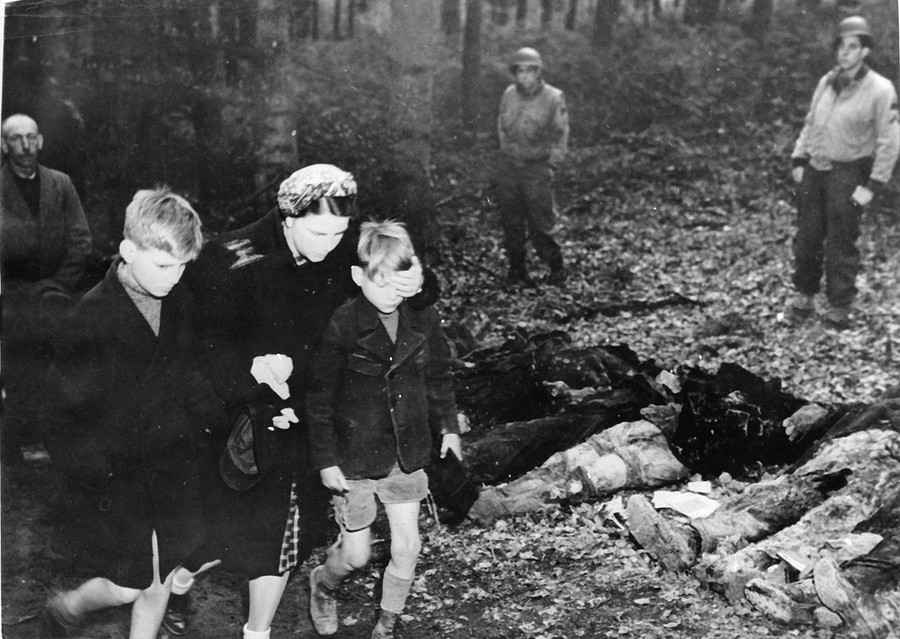
A German mother shields the eyes of her son as they walk with other civilians past a row of exhumed bodies exterior Suttrop, Germany. The bodies were those of 57 Russians killed by German language SS troops and dumped in a mass grave before the arrival of troops from the U.South. Ninth Ground forces. Soldiers of the 95th Infantry segmentation were led by informers to the massive grave on May 3, 1945. Before burying, all German civilians in the vicinity were ordered to view the victims. #
U.Southward. Holocaust Memorial Museum, U.S. Army Signal Corps
We desire to hear what you think about this article. Submit a letter to the editor or write to messages@theatlantic.com.
Source: https://www.theatlantic.com/photo/2011/10/world-war-ii-the-holocaust/100170/
0 Response to "What Happened to the German Soldier's Family in Valkyrie"
Postar um comentário