Art on Screen Caravaggio the Soul and the Blood March 31
Interview with Cosetta Lagani, manager of "Sky Art Movie theater" (Movie theater d'Arte Heaven). Highlights on the film "Caravaggio. The soul and the claret", that will premiere in Italy on February 19 . The new project: "Michelangelo. Infinite", due to be released in Italian cinemas in 2018
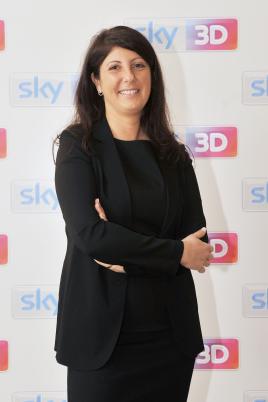
The moving-picture show "Caravaggio. The soul and the blood", the new documentary of Heaven Art Cinema, produced by Heaven and Magnitudo, in cooperation with Vatican Media (Communications Secretariat of vatican city) will premiere in cinemas across Italy on February nineteen. The documentary was produced under the auspices of the Ministry of Cultural Affairs' Cinema Directorate General, with the patronage of the Municipality of Milan and in cooperation with Palazzo Reale. For the occasion SIR interviewed the coordinator and creative director of "Heaven Art Movie house" productionsCosetta Lagani, for a journey to the discovery of Caravaggio and of the new projection on Michelangelo (to be released in 2018).
How has the depiction of fine art changed on the big screen? When nosotros released our starting time "Sky Fine art Cinema" product in 2013, "The Vatican Museums 3D", fine art documentaries were not however being screened in motion picture theatres. A few productions had been made abroad, but they basically consisted in on-screen exhibitions. "The Vatican Museums 3D" contributed to this radical transformation.
Information technology was positioned outset place at the Italian box function and was screened in motion-picture show theatres beyond threescore countries, registering a tape-breaking number of viewers in terms of art productions worldwide, with an audience of over 250 one thousand viewers.
These are loftier numbers not only for a documentary but also for Italian movie productions abroad, that clearly betoken to the loftier request of innovative, educational audiovisual content illustrating the dazzler of our Country. From "The Vatican Museums 3D" onward, fine art productions became a new line of business for many international producers and broadcasters equally for Sky, that since then decided to produce art movies for the big screen on a regular footing of which I am the coordinator and artistic managing director. Such productions include: "Firenze east gli Uffizi" (2015), "San Pietro e le Basiliche Papali di Roma" (2016), "Raffaello il Principe delle Arti" (2017) and the two new fine art-films "Caravaggio. The soul and the claret" and "Michelangelo, infinite."
What is the specific feature of these art documentaries? The strength of these productions can be summarised in a give-and-take:
Innovation.
Innovation with regard to the narrative arroyo (never purely didactic but rather emotional and masterful), and to the visual language (with state-of-the-art shooting and mail service-production techniques); all is placed at the service of artistic sites and works of art, thereby enabling viewers to experience them in total, with unprecedented, powerful emotional interest. Before our films nobody had put cutting-edge filming technology at the service of fine art (with 3D screening, 4K, art dimensioning forms). It was a winning choice because technology (not as an terminate in itself simply placed "at the service of…") tin give a fundamental contribution in enhancing and intensifying art'south emotional impact. After the film on Raffaello we started working to bring to completion the dialogue between movie theater and art, with the back up of historians and art experts serving as scientific advisors for the picture.
 Y'all have contributed to the cosmos of compelling audiovisual productions in cooperation with the Communications Secretariat and the Vatican Museums. How did these projects with the Holy Run into come about?
Almost all of our art movies accept been produced in cooperation with the Vatican Museums and the Communications Secretariat. I am very grateful to these Institutions for the confidence given to united states and the precious cooperation, without which these projects would not be. State of the vatican city has some of humanity's greatest art collections, attracting millions of visitors ever yr from world countries. An fine art project worthy of its name cannot prescind from these sites and from these works of art. Nevertheless, what I had the privilege to accomplish with these important Institutions of faith and art is more than I had hoped, a synergy of purpose capable of blending tradition and innovation for the joint development of a continual planning program. This synergy of purpose came into being in 2013 with the Vatican Museum'southward direction of "The Vatican Museums 3D", in 2014 with the Vatican Tv set Centre, and since its establishment with the Communication Secretariat for the live streaming of the canonization of Pope Wojtyla and Pope Roncalli, the related documentary presented at the Festival of Rome and shortly after the moving-picture show "Saint Peter and Rome'southward Papal Basilicas" for the Extraordinary Jubilee of Mercy.
Y'all have contributed to the cosmos of compelling audiovisual productions in cooperation with the Communications Secretariat and the Vatican Museums. How did these projects with the Holy Run into come about?
Almost all of our art movies accept been produced in cooperation with the Vatican Museums and the Communications Secretariat. I am very grateful to these Institutions for the confidence given to united states and the precious cooperation, without which these projects would not be. State of the vatican city has some of humanity's greatest art collections, attracting millions of visitors ever yr from world countries. An fine art project worthy of its name cannot prescind from these sites and from these works of art. Nevertheless, what I had the privilege to accomplish with these important Institutions of faith and art is more than I had hoped, a synergy of purpose capable of blending tradition and innovation for the joint development of a continual planning program. This synergy of purpose came into being in 2013 with the Vatican Museum'southward direction of "The Vatican Museums 3D", in 2014 with the Vatican Tv set Centre, and since its establishment with the Communication Secretariat for the live streaming of the canonization of Pope Wojtyla and Pope Roncalli, the related documentary presented at the Festival of Rome and shortly after the moving-picture show "Saint Peter and Rome'southward Papal Basilicas" for the Extraordinary Jubilee of Mercy.
We brought the art and the culture of world dazzler on the large screen, also in Countries of Southward America, Asia, and, recently, too in Communist china.
From "The Vatican Museums 3D" to "Raffaello": documentaries on Italian art with a strong appeal on foreign markets. What are the potentialities for the audiovisual sector? The results of these commencement films were surprising. The combination of "fine art, cinema and technology", and at the same fourth dimension the dialogue betwixt tradition and innovation, proved to be winning choices, alluring an increasingly large and heterogeneous audience in movie theatres worldwide. Under a sure angle it can be said that we created a brand and developed a new motion picture genre. The films take all been successful at Italy's box office with record-breaking numbers of viewers in this segment on Sky. The greatest surprise came from abroad: they were screened in some 2000 cinemas worldwide and in many of them they ranked among the height 5 or elevation 10 placements in the box role. In this respect Colombia was among the greatest surprises with 75% of pic theatre tickets sold every day in which our films were screened, while the art historians of our films have become veritable celebrities. And recently in China, where our films premiered in 20 motion picture theatres beyond 10 Chinese cities, tickets were sold-out about everywhere.
 Two more documentaries dedicated to Renaissance artists Michelangelo and Caravaggio are in the pipeline. Could you lot anticipate something about them? Our movies consist in constant narrative, visual and technological experiments. In this respects the films on Caravaggio and Michelangelo are a farther innovative footstep: they are very different from one some other in terms of narrative, stylistic and visual choices, simply they are too very unlike from the previous ones. For Caravaggio we developed an unprecedented way of describing one of the virtually historic – and controversial – artists. In technical terms we were amid the first in Italy to experiment with Magnitudo moving picture, 8K filming – the current highest ultra high definition – forth with cutting-border CGI techniques that fully draw the emphases of lights and shadows characterising Caravaggio'southward paintings, two technological "stratagems" that have enabled the states to "give substance" to his masterpieces thereby producing a unique perception of them, providing a "quasi-tactile" feel to viewers.
 What about the narrative attribute? In line with Caravaggio'southward contemporariness nosotros decided to represent the expressions of his soul in an abstract, linear contemporary setting, staging common people and not actors (simply equally were the models he used for his portraits). In these powerful, evocative scenes the characters' interpretation is real and without filters thus the audience is led to a familiar place, putting them into direct contact with the man Caravaggio. The scenes are narrated by the voice-over of Caravaggio's personage interpreted by a bang-up contemporary artist, Manuel Agnelli, under sure angles with akin talent and artistic choices.
 Could you tell united states something about the work on Michelangelo?
"Michelangelo. Infinite", marks a decisive step towards the transformation of these products in veritable films with "administrative fiction" and a departure from traditional documentaries. The innovative idea of the script was to develop the narration on the works of art within a "masterful" fictional context. On screen we see Michelangelo (with the outstanding operation of Enrico Lo Verso) who inside an evocative Carrara marble quarry retraces his life, his inner restlessness and turmoil, his creative malaise. The narration is entrusted to art historian Giorgio Vasari (masterfully interpreted by Ivano Marescotti), who knew Michelangelo and thus witnessed episodes of his life and artistic creations. The historic and artistic account is expressed through their narrations and recollections, that include suggestive images of Michelangelo crafting the masterpiece Sistine Chapel ceiling and Last Sentence, along with their utter involvement in the realm of their artistic creation. The film will feature all of Michelangelo's major sculptures and vast pictorial production, in improver to many drawings, with filming of the works from unprecedented perspectives and private sites, not open up to the public. The projection, a joint production of Sky and Magnitudo, was developed thanks to previous cooperation with the Vatican Museums and with the Communications Secretariat. The movie volition be screened in movie theatres in 2018.
Could you tell united states something about the work on Michelangelo?
"Michelangelo. Infinite", marks a decisive step towards the transformation of these products in veritable films with "administrative fiction" and a departure from traditional documentaries. The innovative idea of the script was to develop the narration on the works of art within a "masterful" fictional context. On screen we see Michelangelo (with the outstanding operation of Enrico Lo Verso) who inside an evocative Carrara marble quarry retraces his life, his inner restlessness and turmoil, his creative malaise. The narration is entrusted to art historian Giorgio Vasari (masterfully interpreted by Ivano Marescotti), who knew Michelangelo and thus witnessed episodes of his life and artistic creations. The historic and artistic account is expressed through their narrations and recollections, that include suggestive images of Michelangelo crafting the masterpiece Sistine Chapel ceiling and Last Sentence, along with their utter involvement in the realm of their artistic creation. The film will feature all of Michelangelo's major sculptures and vast pictorial production, in improver to many drawings, with filming of the works from unprecedented perspectives and private sites, not open up to the public. The projection, a joint production of Sky and Magnitudo, was developed thanks to previous cooperation with the Vatican Museums and with the Communications Secretariat. The movie volition be screened in movie theatres in 2018.
Every bit a woman you succeeded in affirming yourself in a sector with a prevailing presence of men in top managerial positions. What is your communication to the young generations? The bulletin and the best advice I could give to immature people wishing to work in the field of audiovisual production (although it could be said for all sectors) stems from my profession:
passion, determination, reliability, passionate commitment, ability to promote cooperation based on similarity of visions and synergy of purpose, along with a lot of marvel, the backbone of post-obit personal intuitions and running well idea-out risks.
The opportunities in the audiovisual sector are presently huge: Italy'south creative industry is in full bloom. In that location are ongoing opportunities for innovation, the international scenario and the related opportunities of cooperation are increasingly interesting, also with the entrance of China on this market. In this scenario, working in a context such every bit that of Sky, that made the constant quest for quality and innovation the core values of its Deoxyribonucleic acid, is extremely stimulating.
Source: https://www.agensir.it/italia/2018/01/25/caravaggio-the-blood-and-the-soul-lagani-sky-our-strength-innovation/
0 Response to "Art on Screen Caravaggio the Soul and the Blood March 31"
Postar um comentário